

AIED 2026 발표 소식
Five research papers from the IDL Lab have been accepted for presentation at AIED 2026, an A-ranked conference in the CORE Conference Ranking that places among the top 13.09% of ranked computer science venues. The papers will be presented at AIED 2026, held in Seoul, Republic of Korea, from June 29–July 3, 2026.
Full Paper · AIED 2026
Ga Young Lee, Hyo-Jeong So
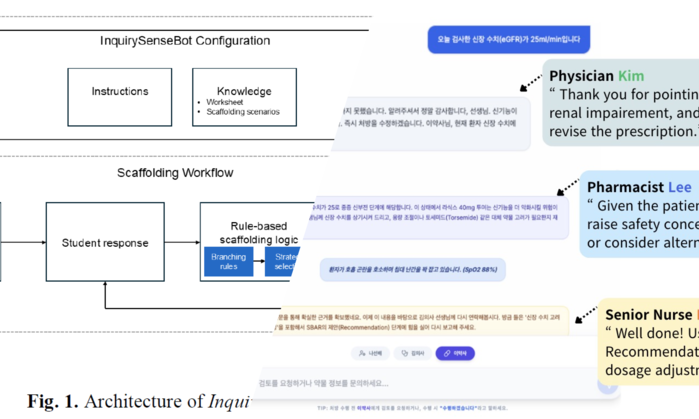
Lee and So (2026) designed InquirySenseBot, a generative AI-based chatbot that scaffolds students’ sensemaking by providing support aligned with phase-specific types of scientific uncertainty in middle school STEM inquiry-based learning. The findings showed that students who used the chatbot demonstrated significantly higher inquiry performance compared to those who did not, with significant gains in research question formulation, hypothesis formulation, experiment planning, and drawing conclusions.
Short Paper · AIED 2026
Eunyoung Kim, Hyosung Park, Subin Yu, Jiyeong Shin, Hyo-Jeong So
Kim et al. (2026) designed an adaptive multi-agent learning environment (IPES) to support interprofessional communication training in nursing education and conducted an initial usability evaluation with nursing students. By integrating role-based AI agents and real-time SBAR-based scaffolding, the study explored the potential of supporting collaborative communication and role negotiation in healthcare education.
Poster · AIED 2026
Yue Wang, Yeji Ko, Sieun Park, Hyo-Jeong So
Wang et al. (2026) introduces PersonA.I., a branching-narrative role-playing game with conversational agents designed to support AI ethics learning. A mixed-methods pilot study found that the game provided positive, immersive experiences and encouraged students to deliberate carefully and take the perspective of multiple stakeholders during the gameplay.
Doctoral Consortium · AIED 2026
Lingxi Jin, Hyo-Jeong So
Jin and So (2026) proposes a pedagogical steering framework that enables LLM-based teachable agents to support tutors’ reflective knowledge building in Learning-by-Teaching through formalized tutoring strategies.
Workshop Paper · MAAI Workshop at Festival of Learning 2026
Eunyoung Kim, Kyuwon Kim, Hyo-Jeong So
Kim, Kim and So (2026) investigates learners’ affective changes surrounding in-video quizzes in video-based learning environments and explores how affect-adaptive quiz delivery shapes emotions such as confusion. By viewing quizzes not merely as assessment tools but as learning activities that support affective changes, the study emphasizes the importance of learners’ emotional states in video-based learning design.